Incoterms
Meaning ~ Standardised abbreviations published by the International Chamber of Commerce allocate transport costs, risk of loss, and logistical duties in trade contracts.


Origin
International commercial terms, widely known as incoterms, comprise eleven standardized three-letter abbreviations that allocate risks, expenses, and logistical tasks between buyers and sellers in cross-border trade contracts. Published by the International Chamber of Commerce, these rules establish the moment of risk transfer for goods in transit and define which party handles customs declarations and transport arrangements. They reside within the sales contract as a three-letter term followed by a specified geographic location and the edition year.
These rules govern the physical movement of tangible goods across borders but do not address ownership transfer, breach remedies, price adjustments, or payment methods. Transfer of title, for instance, resides in a separate sales contract clause, independent of the selected delivery term.
By appending the phrase CIF Hamburg Port Incoterms 2020 to a purchase contract, the parties incorporate the International Chamber of Commerce rule and replace default regional statutory sales rules with international standards.

Transit
The eleven standard codes split into two broad categories: those for any mode of transport and those reserved exclusively for sea or inland waterways.
The risk of transport damage transfers to the buyer before the main carriage begins under all main carriage paid terms, regardless of who pays the freight.
To avoid disputes, containerized shipments generally rely on multimodal terms, where risk shifts at origin, whereas loose bulk cargo loaded directly onto vessels uses maritime-only rules. Multimodal options provide the necessary flexibility for contemporary supply chains that move goods by rail, road, or air before ocean transport.
- Departure contracts place the lowest burden on the supplier by requiring them only to make packaged goods available at their own facility.
- Main carriage unpaid terms oblige the exporter to deliver cleared goods to a carrier of the importer’s choice. The buyer assumes all subsequent transport expenses.
- Main carriage paid agreements separate the risk-transfer point from the cost-allocation point. While the supplier pays freight to the destination port, the risk moves to the buyer at the origin loading terminal.
- Arrival contracts require the seller to shoulder all expenses and risks until the cargo arrives at the designated destination. Unloading obligations depend on the specific selected term.
Exporters shipping cargo in steel containers choose multimodal rules over maritime terms to prevent risk from transferring before the carrier receives the freight.
Dock
Maritime trade hinges on the precise point where cargo crosses the ship’s rail, establishing the moment of delivery.
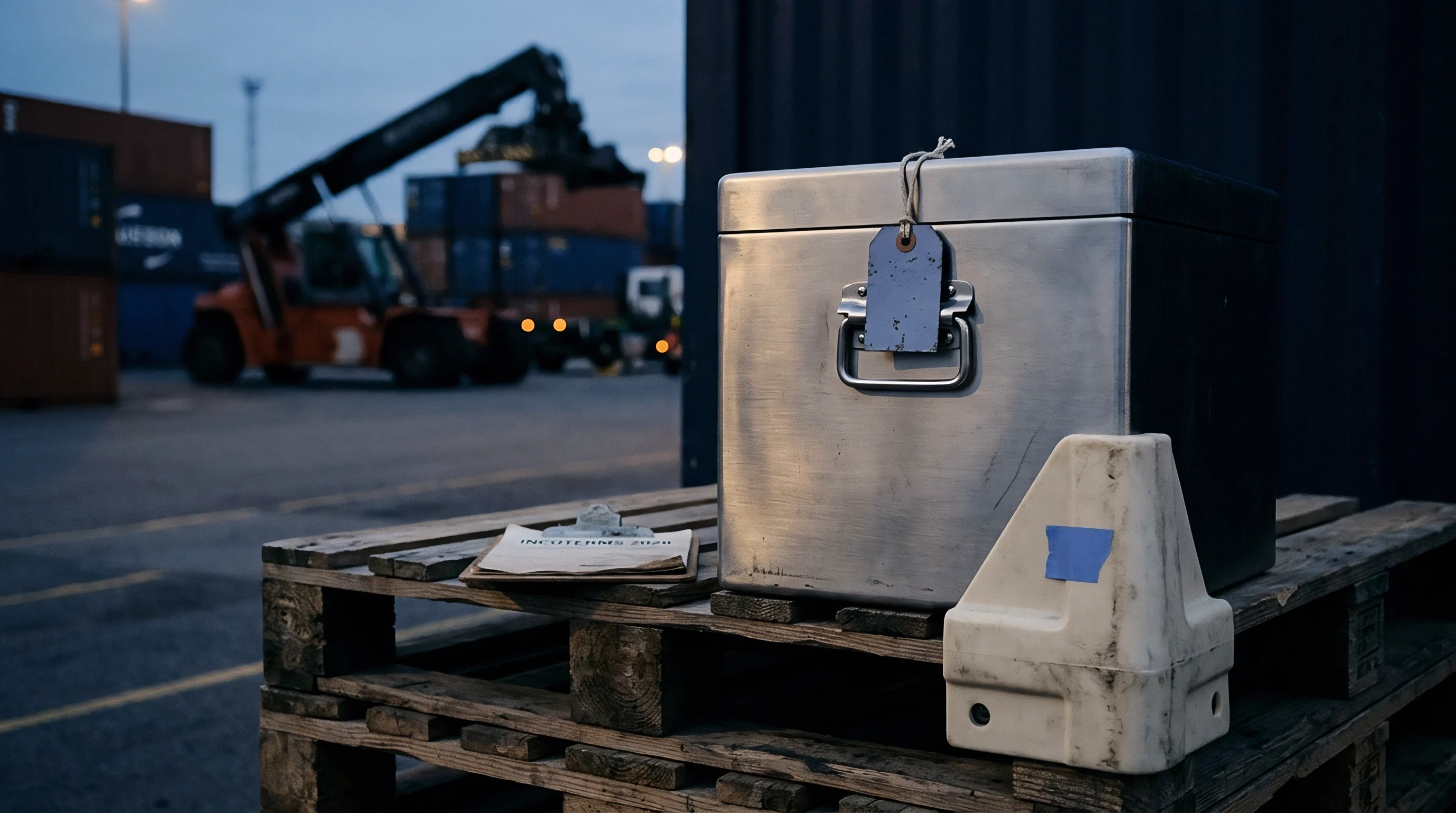
On a windy afternoon at the terminal, the physical loading of the container represents the boundary of liability. The moment the vessel’s gantry crane locks its spreader onto the container’s corner castings and lifts the box over the rail, the risk of loss is in suspension. Under Free on Board rules, delivery executes the instant the container is safely positioned on board the vessel.
If the cable snaps prior to the container clearing the rail, the risk remains with the seller. If the container is dropped after being positioned on the deck, liability lands on the buyer, with unloading requiring a separate agreement.
Failure to align the transfer point with the actual point of handover to the first carrier leaves the exporter bearing cargo damage costs for accidents occurring during regional transport.

Arithmetic
Costing calculations for global supply contracts require separate lines for manufacturing, handling, and logistics fees to establish the true final pricing.
A supplier who contracts to ship under CIP purchases cargo insurance covering a minimum of 110 percent of the transaction value in the currency of the contract.
Insurance obligations differ substantially between the two terms that require seller-provided coverage. Each term maps to a specific tier under the Institute Cargo Clauses, creating distinct levels of protection for the buyer.
| Rule Category | Insurance Clause | Default Coverage | Value Baseline |
|---|---|---|---|
| CIF (Sea Freight) | Institute Cargo Clauses (C) | Named perils only, excluding water damage and theft | Contract value plus ten percent in contract currency |
| CIP (Multimodal) | Institute Cargo Clauses (A) | All-risks coverage, with narrow standard exclusions | Contract value plus ten percent in contract currency |
Costing steps for establishing total landed prices follow a clear progression of financial additions from origin to destination.
- Ex-works pricing is established by calculating the basic manufacturing expense and factory packaging costs.
- Inland transport charges and origin terminal handling fees are added to determine the free carrier baseline price.
- Ocean freight and marine insurance premiums are compiled next. They match the carrier contract rates and the mandatory minimum cover.
- Import customs duties, clearance fees, and final mile delivery expenses are incorporated to establish the ultimate landed cost. This figure includes any non-recoverable value-added tax.
Finished goods moving under CIF terms require only named-perils coverage under commodity standards unless contracts explicitly mandate all-risks insurance.
When buyers request all-risks coverage for CIF ocean shipments, standard trade rules only mandate the cheaper named-perils policy.

Paperwork
Documentation acts as the physical surrogate for cargo, enabling banks and customs agents to verify compliance before physical goods reach the warehouse, with sellers covering export clearance costs.
Discrepancies between shipping documents and the sales contract can stall payment transfers or trigger heavy fines at the port of arrival. Ensuring that the specific rule listed on the invoice matches document fields provides a key defense against administrative friction.
- Sea waybills act as non-negotiable transport receipts used for ocean carriage where no physical bill of lading is needed.
- Multimodal bills of lading represent the contract of carriage and receipt for goods shipped by more than one mode of transport, including rail and sea.
- Certificates of origin serve as the official declaration proving the country where the goods were manufactured, which is needed to calculate preferential duty rates.
- Commercial invoices specify the transaction value and the exact chosen trade term, which is needed for customs valuation at the border.
Exporters manage security filings, including the importer security filing in the United States, by coordinating with their freight forwarders. Under FCA, the exporter compiles the security information while the importer files the ultimate entry, preventing regulatory delays at the arrival port.


Ledger
Customs duties and tax clearances represent the final and most complex financial reconciliations in international logistics.
An overseas seller shipping goods under DDP into the United Kingdom faces an absolute loss of the twenty percent import VAT if they file the entry without a local non-resident tax registration.
The practical difference between DAP and DDP centers on who clears customs and pays duties. When using DAP, the buyer handles the import process and recovers local tax payments. Under DDP, the seller assumes the function of importer, which often presents major local tax challenges for foreign entities.

Does Delivered Duty Paid Require Local Tax Registration?
A seller using DDP requires a local entity or a registered non-resident agent in the destination country to clear the goods as the Importer of Record. If the seller has no such registration, they cannot complete the import filing. This forces them to employ an agent, incurring high fees, or to request the buyer to act as importer, which violates the contracted delivery term.
| Obligation | DAP (Delivered at Place) | DDP (Delivered Duty Paid) |
|---|---|---|
| Import Entry Filing | Buyer acts as Importer of Record | Seller arranges local clearing agent |
| Duty Payment | Buyer pays local customs directly | Seller includes duty in price |
| Import VAT Status | Recoverable as input credit by buyer | Often lost to seller without local registration |
This division raises the persistent question of whether a buyer can legally claim input VAT deduction for import transactions cleared under DDP by an unregistered foreign entity.