Risk Transfer
Meaning ~ Reallocation of financial liability for cargo damage during transit, defining where the seller's exposure ends and the buyer's responsibility begins.


Passage

Legal Title versus Risk of Loss
Reallocating liability for physical loss, damage, or deterioration of goods from a supplier to a buyer sets the legal boundary determining which balance sheet absorbs transit failures. Ownership often remains with the shipper until final invoice clearance, even though responsibility for transit accidents shifts much earlier in the supply chain. This transition, designated as risk transfer, is governed by standardized trade definitions and international sales treaties that dictate the exact geographic and temporal point where the buyer assumes financial exposure for damaged cargo.
Legal ownership of the physical goods remains with the party holding the original bill of lading, even when the liability for transit damage has already passed to the buyer.
Placing cargo with a steamship line or air freight operator does not automatically transfer legal title. Under standard sales contracts, title passes upon payment or receipt of original shipping documents, while exposure to damage shifts according to the agreed trade term. Importers who confuse these milestones face substantial financial vulnerability, particularly when paying for cargo before physical risk of loss has shifted to them.

The Limits of Cargo Responsibility
A seller’s liability ends once they complete the specific delivery obligation defined in the trade clause. Beyond that boundary, subsequent damage falls to the buyer, and the physical location of this line dictates which company files a claim with its underwriters. The ultimate test of this separation occurs when mandatory national insolvency rules override contractual risk allocation during a bankruptcy filed while cargo is at sea.


Instrument

Standard Trade Rules in Action
Standardized international rulebooks codify the split of duties and costs between trading parties to prevent regional legal variations from disrupting shipping lanes. Incorporating International Chamber of Commerce rules into purchase agreements provides a clear legal baseline. Organized under specific three-letter codes, these clauses detail delivery obligations under Clause A2 and corresponding transitions under Clause A3, preventing drawn-out litigation when containers fail to arrive in pristine condition.
| Incoterm | Risk Transfer Point | Transport Contract Party | Default Insurance Obligation |
|---|---|---|---|
| EXW | Seller warehouse floor before loading | Buyer | None specified |
| FCA | Delivery to first carrier inland terminal | Buyer | None specified |
| CPT | Delivery to first carrier inland terminal | Seller | None specified |
| CIP | Delivery to first carrier inland terminal | Seller | Seller holds obligation under Clause A coverage |
| DAP | Unloaded vehicle at buyer designated place | Seller | None specified |
The tabulated comparisons highlight how different clauses allocate responsibilities across specific rules.
- risk transfer occurs when the seller places the goods at the disposal of the buyer’s carrier at the designated inland depot under the FCA rule.
- risk transfer moves to the buyer only after the cargo has been unloaded from the arriving conveyance at the named terminal under the DPU rule.
- risk transfer shifts the moment the supplier delivers the goods on board the designated vessel at the specified port under the FOB rule.

Default Statutory Provisions
When contracts omit a specific trade clause, the United Nations sales convention fills the vacuum with statutory default rules. Articles 66 to 70 of the United Nations Convention on Contracts for the International Sale of Goods govern risk movement in international sales. Under Article 67, when a transaction involves carriage, liability transfers to the purchaser once the seller hands the items over to the first independent carrier.
Matching an insurance policy’s start date to the contractual delivery point prevents balance-sheet exposure from split-liability ambiguities during terminal handling.

Dock

Verifying Condition at Handover Points
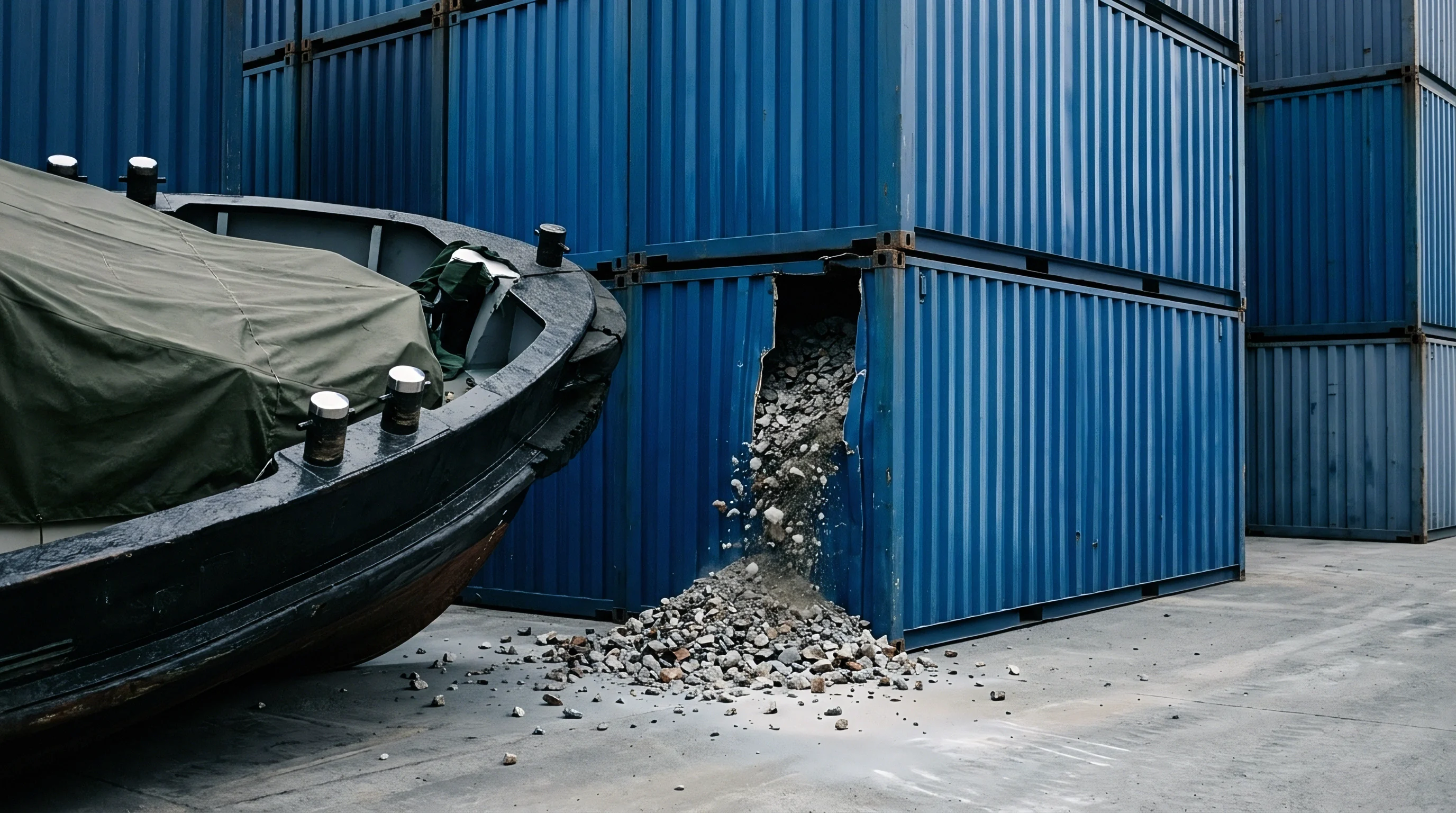
The physical handover of cargo is where written contractual terms meet real-world handling and custody. An inspector examines the exterior of the shipping container for structural integrity before signing the yard transfer receipt, creating a primary defense against inheriting pre-existing damage. Physical transfers occur at designated sites like container yards, marine terminals, or warehouse loading docks, where inspectors log seal numbers and check for structural distortion.
Cargo loaded onto the collecting vehicle under Ex Works terms travels at the buyer’s sole risk from the moment the pallets sit on the warehouse floor.
Standing water or crushed cardboard boxes from pallets left outdoors indicate that damage occurred before custody passed to the transport carrier. The inspector notes these defects on the warehouse release docket before departure; if a driver signs without recording them, responsibility for the deterioration falls on the transport company. This physical ledger forms the core evidence for resolving subsequent insurance claims.

The Role of First Carrier Delivery
In multimodal transport, transferring goods to the initial trucking company shifts the risk of subsequent damage to the purchaser. Multi-mode shipments frequently rely on Free Carrier terms, under which the supplier fulfills their obligation as soon as the truck departs their facility. This handover is sensitive because buyers are rarely present to check loading quality, and damage discovered at the destination terminal is often attributed to rough maritime transit or heavy seas occurring after the seller’s liability ended.


Arithmetic

Who Bears the Loss during Carrier Delays?
The financial impact of lost or destroyed cargo extends well beyond direct manufacturing costs. Demurrage and storage charges accumulate quickly when customs authorities hold a shipment for administrative audits, and these indirect expenses fall on whichever party bears risk during that transit leg. Total loss calculations combine unit manufacturing costs, unrecoverable import duties, and air-freight surcharges paid to expedite replacement shipments.
The supplier remains exposed only if the delay occurred before the designated delivery terminal boundary.
International road carriers under the CMR convention limit their financial liability to 8.33 Special Drawing Rights per kilogram for damaged or missing goods.
When claims arise, underwriters evaluate statutory liability caps established by maritime or road conventions. Because these default limits rarely cover the full value of precision manufacturing components, the buyer absorbs any uncovered balance unless they secured a separate, full-value cargo insurance policy prior to risk transfer.
| Convention | Applicable Mode | Liability Limit per Kilogram | Liability Limit per Package |
|---|---|---|---|
| Hague-Visby Rules | Ocean Freight | 2.00 SDR | 666.67 SDR |
| Hamburg Rules | Ocean Freight | 2.50 SDR | 835.00 SDR |
| Montreal Convention | Air Freight | 22.00 SDR | Not applicable |
| CMR Convention | Road Transport | 8.33 SDR | Not applicable |
| Special Drawing Rights values are determined by the International Monetary Fund and converted to local currencies on the date of the claim settlement. | |||

Inherent Limits of Transport Liability
International conventions set default liability caps that insulate carriers from paying full value for high-value cargo. These limits are calculated in Special Drawing Rights, a reserve asset defined by global monetary standards. Importers of lightweight, high-value components face substantial financial risk if they rely solely on carrier liability.
Adding a Standard Carriage Risk Addendum ensures ground transport between port and warehouse remains the seller’s responsibility, even during administrative delays.


Dispute

Moisture Ingress in Electronic Subassemblies
When water penetrates a sealed steel container at sea, determining who bears the financial loss depends entirely on when the moisture entered. Consider an order of ten thousand electronic subassemblies valued at eighty thousand dollars under Free Carrier terms, where risk shifts to the buyer once the carrier takes delivery of the sealed container at the inland rail yard. When the shipment arrives at the destination facility, forty percent of the units suffer condensation corrosion that destroys the circuit boards.
To identify the responsible party, a maritime surveyor reviews data from an integrated digital datalogger inside the crates. The logger recorded a sudden humidity spike to ninety-five percent while the container was held at the railway terminal prior to vessel loading. This confirms that the damage occurred after delivery to the carrier, meaning the buyer bears the loss, pays the supplier’s invoice in full, and seeks recovery through their cargo insurance underwriters.

Resolving Boundary Discrepancies
Reaching a settlement between seller and buyer requires matching ocean carrier logs with container transit itineraries. Claims adjusters follow a structured sequence to pinpoint where failure occurred.
- Receiving agents inspect exterior container seals and record serial numbers on the delivery docket immediately upon arrival.
- Warehouse supervisors open container doors and document shifted crates or ruptured bracing using high-resolution photographs.
- Quality control inspectors check internal humidity levels and inspect color-changing moisture indicator cards inside protective foil barriers.
- Procurement directors submit formal written notice of damage to both supplier and carrier within the three-day statutory maritime window.
This systematic process highlights the vulnerability of buyers who rely on general commercial assurances instead of verifiable sensor data.


Paperwork

Essential Maritime Cargo Certificates
Pinpointing the exact moment of delivery and liability transfer requires an unbroken chain of physical receipts and electronic records. A clean bill of lading provides primary proof that the carrier accepted cargo in apparent good order and condition. Its issuance marks the point where the shipper surrenders custody and buyer transport risk begins.
If a bill of lading contains exceptions noting rust, leakage, or damaged banding, risk transfer is compromised, leaving the shipper liable for pre-existing defects logged prior to loading.

The Legal Weight of Receipts
Forwarder certificates of receipt and road consignment notes set the timeline for transport actions. Discrepancies between consignment dates and physical loading dates can invalidate transit insurance policies. Failing to align bills of lading with physical handover points leaves importers exposed to both the cost of damaged cargo and port authority salvage claims.