Letter of Credit
Meaning ~ A trade finance instrument issued by a bank that guarantees payment to a seller upon the presentation of compliant shipping and commercial documents.


Ledger
When a financial institution executes a documentary bill of exchange, it commits to paying a seller a specified sum upon presentation of defined transport and commercial documents. This obligation underpins international trade, stepping in between an overseas buyer and a manufacturer who may never have met and operate under different legal systems. Rather than relying on the buyer’s creditworthiness or willingness to pay, the transaction rests on the credit of the issuing bank.
The manufacturer gets a guarantee of payment if they present the exact papers required, while the buyer knows their funds won’t be released until documents prove the cargo is loaded on board for shipment.
Globally, this payment method is governed by the Uniform Customs and Practice for Documentary Credits, issued by the International Chamber of Commerce as publication number six hundred. Under these rules, banks deal strictly with documents, not the physical goods behind them. An examiner won’t open containers or test the chemical composition of steel coils; they simply check the words and figures on the invoice, packing list, insurance certificate, and bill of lading against the conditions of the credit.
If everything matches on paper, the bank must release the funds, keeping the financial contract separate from the purchase agreement itself.
Irrevocable credits provide certainty when working with new suppliers in unfamiliar regions. The arrangement creates three distinct contracts: first, the sales contract between buyer and seller covering goods, prices, and shipping terms; second, the buyer’s reimbursement agreement with their own bank when applying to open the credit; and third, the credit sent by the issuing bank to the seller through an advising bank in the seller’s country. Each contract stands on its own.
A dispute over cargo quality does not relieve the bank of its duty to pay, so long as the seller’s documents comply with the credit.
That independence protects both sides from opportunism. A buyer cannot hold the seller hostage for a late discount because market prices dropped after ordering, nor can a seller demand payment before cargo is in transit or divert capacity elsewhere. This protection breaks down only if the seller commits outright fraud that is documented and put before a court before the bank executes the wire transfer.
Short of an injunction, the paper trail controls everything. It remains the standard approach for high-value commodities, heavy equipment, and custom manufacturing where raw materials must be bought before production begins.
That leaves open the question of how an importer can verify the physical quality of custom tooling when the bank pays purely against paper declarations.
Transit
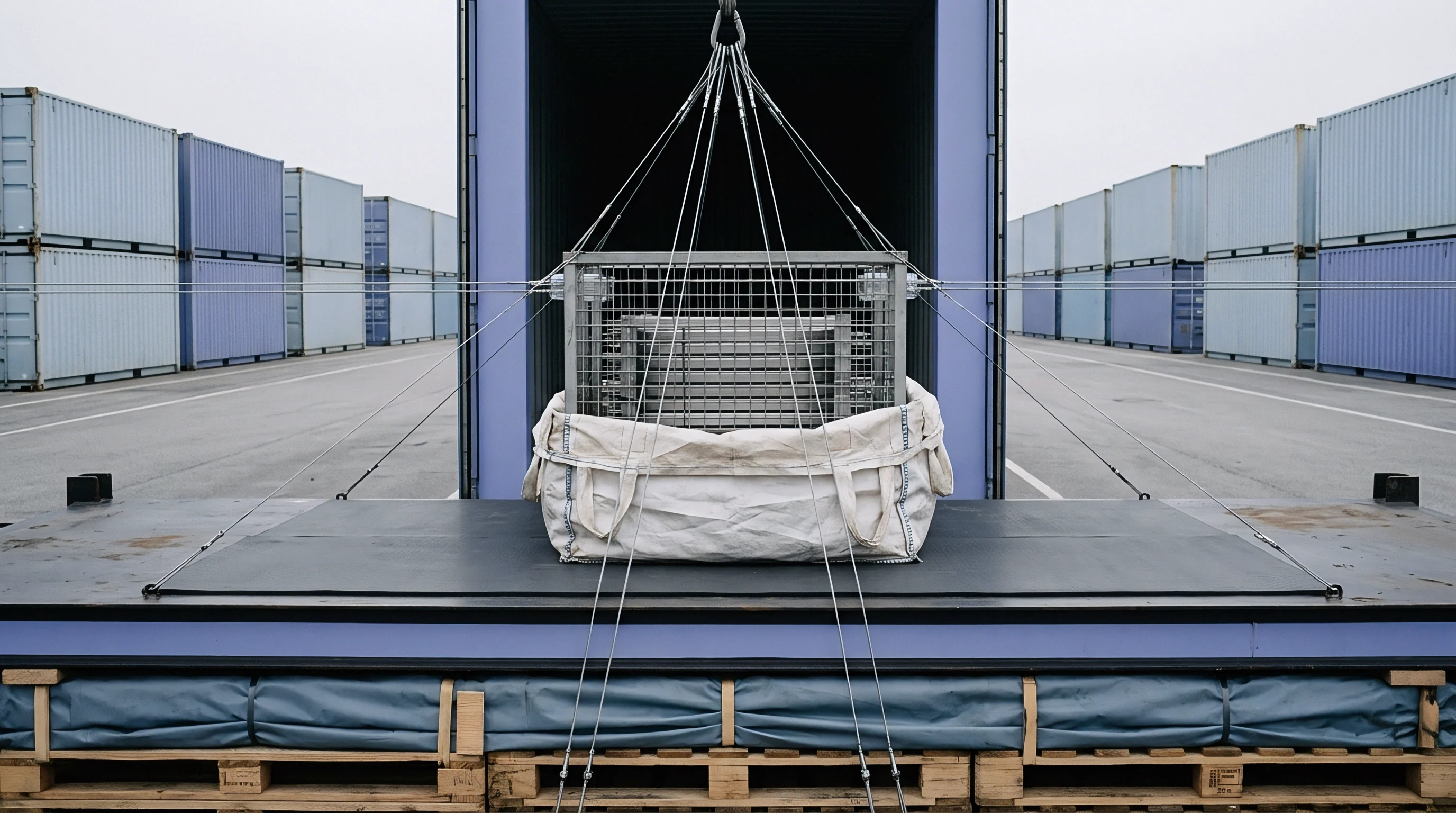
Cross-border ocean transit leaves cargo in the carrier’s custody for weeks, out of reach of both buyer and seller. The ocean bill of lading bridges this gap, acting as a receipt, evidence of the carriage contract, and a document of title. It is the most critical document presented to the bank.
To trigger payment, the bill must be clean and state that the cargo has actually been loaded on board.
A “clean” bill means the carrier noted no visible defects in the packaging or goods during loading. If a mate’s receipt or bill of lading carries notations like wet cartons or ruptured steel bands, the document is considered fouled, and the bank will reject it. This protects the buyer from paying for cargo damaged before leaving port.
Because title moves with the paper, making the bill of lading to the order of the issuing bank prevents the buyer from claiming the shipment at destination until they reimburse the bank and receive the endorsed bill.
Article twenty of the Uniform Customs and Practice for Documentary Credits dictates that a transport document showing transshipment will be accepted even if the credit prohibits transshipment, provided the goods are in a container.
The chosen Incoterm decides who arranges and pays for transport, directly shaping document requirements. Under Free on Board terms, the buyer books freight and nominates the vessel, while the seller delivers cargo to the port and loads it, receiving the bill of lading to present to the bank. Under Cost, Insurance, and Freight terms, the seller books carriage and buys marine insurance covering the buyer’s risk during transit.
The credit will then require a negotiable insurance policy or certificate for at least one hundred and ten percent of invoice value, endorsed to the bank or buyer.
As a rule, if the bill of lading is consigned to the order of the issuing bank, the buyer cannot touch the cargo until the bank has cash in hand.

Paperwork
Trade documentation follows a standard schema set by the International Chamber of Commerce, implemented through SWIFT MT700 messages. Every field in this format carries a numerical tag defining specific conditions. Preparing documents requires careful cross-referencing across these fields, as even small inconsistencies can freeze funds.
Field thirty-one-D gives the expiry date and place for the credit ~ the firm deadline for presenting completed documents to the bank. Presenting even a day late relieves the bank of its obligation. Field forty-four-C sets the latest shipment date, which must match the onboard loading date on the bill of lading; if loading occurs after that date, the bank refuses the presentation and payment security disappears.
Field forty-five-A contains the description of goods, which the commercial invoice must match word for word, down to exact spelling or specialized terms.
Some trade arrangements require the testing certificate to come from a specific independent laboratory.
- Letter of credit specifications demand an exact match between the commercial invoice and field forty-five-A to ensure payment.
- Letter of credit applications designate the issuing bank as the sole arbiter of document conformity.
- Letter of credit instructions determine whether partial shipments are allowed, which governs production schedules.
- Letter of credit amendments modify the original terms but necessitate the consent of all active parties to take effect.
Field forty-six-A usually lists the required documents: commercial invoice, packing list, bill of lading, certificate of origin, and inspection report. Every document must align with the rest. If the packing list shows twelve thousand kilograms and the bill of lading reads eleven thousand eight hundred kilograms, the bank flags a discrepancy.
Consignee and notify party names must match perfectly across all paperwork; even missing an abbreviation can prompt a rejection.
When addresses or dates conflict between the invoice and packing list, documents usually end up stuck in a drawer at the negotiating bank while demurrage charges rack up daily at the port of entry.


Discrepancy
Strict compliance is the governing legal principle when bank clerks examine documents. They do not interpret commercial intent or overlook minor administrative errors. If a credit requires a chamber of commerce certificate of origin and the seller submits a self-certified document, it is rejected.
This rigid standard explains why sixty to seventy-five percent of initial document presentations are refused on first submission.
Under Article fourteen-B of the Uniform Customs and Practice for Documentary Credits, the bank has up to five banking days after presentation to evaluate compliance. If it finds discrepancies, it must issue a single notice listing every defect. Under Article sixteen-F, the bank cannot later cite additional discrepancies omitted from that initial refusal, giving the seller a clear baseline when resolving problems.
A document examiner at an issuing bank reviews papers solely on their face and has no mandate to investigate the actual physical status of the cargo.

How Do Buyers Resolve Documentary Rejections?
A refusal notice destroys the payment guarantee, but it does not necessarily kill the deal. Parties typically rely on four main options to resolve the situation.
- The beneficiary retrieves the papers to correct and re-present them before the expiry date.
- The issuing bank contacts the applicant to seek a waiver of the identified errors.
- The negotiating bank forwards the discrepant documents on an approval basis to the issuing bank.
- The parties negotiate a price discount or alternative payment method to bypass the deadlocked credit.
Most cases clear via the second path, where the buyer waives the discrepancies. If the buyer wants the goods and trusts the supplier, they will instruct the bank to release payment despite the clerical errors. Doing so, however, shifts bargaining power to the buyer, who may demand a price cut or extended terms in return.
If market prices have dropped since signing, the buyer can simply refuse the waiver, cancel the transaction, and leave the seller stranded with cargo at the destination port.
Manufacturers often argue that if cargo left port in sound condition, a refusal over a missing comma in a company name is just a pretext to delay the wire.

Arithmetic
Bank commissions and administrative charges directly reduce margins if they aren’t built into pricing up front. These fees are set as a percentage of the credit’s face value, combined with flat charges for specific processing steps.
| Fee Category | Typical Basis | Responsible Party | Estimated Cost (USD) |
|---|---|---|---|
| Issuance Fee | 0.25% of face value | Buyer (Applicant) | 625 |
| Advising Fee | Flat fee | Seller (Beneficiary) | 150 |
| Confirmation Fee | 0.50% of face value | Seller (Beneficiary) | 1,250 |
| Document Examination | Flat fee per draw | Seller (Beneficiary) | 200 |
| Amendment Fee | Flat fee per change | Requesting Party | 150 |
| Estimated Administrative Subtotal | 2,375 | ||
This table reflects a straightforward transaction without edits or delays. When discrepancies arise or shipment dates are extended, fees accumulate quickly. Delays between shipment and payment release show how quickly these costs add up.
Consider a two hundred and fifty thousand dollar transaction delayed fifteen days after a document rejection required both an amendment and a waiver.
The cost of that fifteen-day delay adds up across several areas: a one hundred and twenty-five dollar bank discrepancy fee for processing the non-compliant documents; a one hundred and fifty dollar amendment fee to extend the shipping date; and interest charges on the tied-up capital. At an annual line-of-credit rate of eight percent, holding two hundred and fifty thousand dollars for fifteen days costs four hundred and eleven dollars (calculated as two hundred and fifty thousand dollars times eight percent divided by three hundred and sixty-five days). Finally, cargo sitting in port incurs demurrage at one hundred and fifty dollars per day for ten days past free time, adding another one thousand five hundred dollars.
An issuing bank usually demands a cash collateral margin of one hundred percent from a new buyer before executing a transaction valued above fifty thousand dollars.
These extra costs turn a minor paperwork delay into a major financial penalty. The baseline administrative subtotal of two thousand three hundred and seventy-five dollars increases by two thousand one hundred and eighty-six dollars, bringing total payment fees to four thousand five hundred and sixty-one dollars ~ nearly two percent of the transaction value, which can erase profit margins on industrial components or consumer goods.
Standard trade agreements typically assign issuing bank fees to the applicant, while advising, amendment, and confirmation fees fall to the beneficiary.
Clamp
Quality engineers know that clean shipping documents do not guarantee that delivered materials meet drawing specifications or grade standards. To avoid paying for defective goods, buyers build quality control requirements directly into the credit by specifying a signed inspection certificate from an independent third-party agency as a condition of payment.
| Material Class | Primary Quality Parameter | Required Certificate Type | Acceptance Threshold |
|---|---|---|---|
| Steel Coils | Tensile yield strength | Mill Test Certificate (EN 10204 3.1) | Minimum 355 megapascals |
| Plastic Resin | Melt flow index | Certificate of Analysis | 2.5 grams per ten minutes |
| Cotton Yarn | Tensile single yarn strength | Third-Party Testing Report | Minimum 18 grams per tex |
Structuring technical standards into the credit creates an effective control gate. The advising bank cannot release funds until the seller presents an original testing report or certificate of analysis from a designated laboratory. The document must state that goods were sampled under an agreed statistical plan, such as ISO twenty-eight-fifty-nine-one, and that defects remained within acceptable quality limits.
Without a passing test, the supplier cannot obtain the document required to draw payment.
The buyer protects their investment by requiring that the independent third-party inspection certificate be signed by their nominated inspector before the bank can release funds.
- Letter of credit provisions exclude generic self-certification documents to force the seller to use certified testing laboratories.
- Letter of credit operations depend on the precise alignment of inspection reports with the commercial invoice details to pass bank examination.
- Letter of credit conditions secure the buyer against early payment by requiring the presentation of an on-board shipping receipt.
- Letter of credit documents demand a clear signature and stamp from the authorized third-party inspector on the quality certificate.
While effective, this process demands precision. The inspector must ensure the certificate carries the exact goods description required by the credit, along with purchase order and container numbers. Any variance allows the bank examiner to reject the presentation, delaying payment even when the physical goods are completely defect-free.

Margin
An importer’s trade volume depends heavily on available bank credit lines. Opening a letter of credit consumes borrowing capacity, and banks scrutinize the applicant’s balance sheet, leverage, and payment history before extending trade facilities. If the bank sees elevated risk, it requires cash margins or collateral to cover the exposure.
For established buyers, banks may require only a ten to twenty percent margin ~ or issue credits under unsecured lines ~ allowing buyers to run multiple transactions without tying up cash. Smaller importers or weaker balance sheets, by contrast, face one hundred percent cash collateral requirements. Depositing full cash value into a restricted account from issuance through final settlement locks up operating liquidity for months.
A standby letter of credit offers more flexibility in long-term supply agreements. It permits settlement through cheaper, faster channels like telegraphic transfers, while keeping the bank guarantee in reserve solely in case of default. This cuts administrative and examination costs while maintaining payment security for the seller, though the choice between instruments ultimately depends on bargaining power and commercial trust built over repeated shipments.